Monday, April 16, 2012

A Princess of Mars: Classic Sci-Fi.

A Princess of Mars, Edgar Rice Burroughs' novel of extra-terrestrial adventure was originally supplied to The All-Story magazine in 1912 as a serialization of a novel that had been recently accepted for publication. Initially it was called 'Under the Moons of Mars' and written with a pseudonym, Norman Bean.

The story which centers around the strange Martian exploits of a confederate Civil War veteran called John Carter.
Carter finds himself inexplicably on Mars, after experiencing a kind if 'mental transference'. He is almost immediately captured by the 'green race' of Martians called Tharks, who marvel at his immense strength and agility.
He rises to a place of honor among them, and soon falls in love with a captured princess of the humanoid 'red race' called Dejah Thoris, who is, in fact the Princess of Mars.

Initially, Burroughs worried how his writings would be accepted, as standard 'realistic fiction' was the norm, and novels of fantasy or Gothic style were unpopular and looked down upon by the general readers of the age.
However, his popularity with the 'Tarzan' novels secured him into a position of respect and readability which provided him with more acceptance than he or his publisher expected.
He wrote eleven novels within the series and enjoyed much popularity during their initial release due to a late Victorian Era fascination with the planet Mars brought about by the book 'Mars' by Percival Lowell.
Burroughs' story deals with several major themes, each hotly debated at the time of its publishing. The question of race is heavy in the story, as there are divisions among the humanoid Martians, based on skin-color, but also based on physiological differences. The Tharks having four arms, and being fifteen feet tall, and non humanoid are not recognized as being part of the community of humanoids dwelling there.
There are also the 'great white apes' and other livestock, which all heavily portray earthly counterparts.
The other questions raised by the book are those common to the turn of the twentieth century literary period, namely, politics, borders and countries, technology, politics and love.
Although not strictly a Science Fiction work, being more a 'planetary romance' popular at the time for using alien landscapes and monsters as the setting for human love, the work deals heavily with technology and social commentary; two themes found in almost every example of Science Fiction writing.
Men in Black Book Club will be meeting to discuss 'A Princess of Mars' on Thursday, April 19th at 12, noon in the Asheboro Library Meeting Room.
Feel free to join as at that time.

Wednesday, March 7, 2012

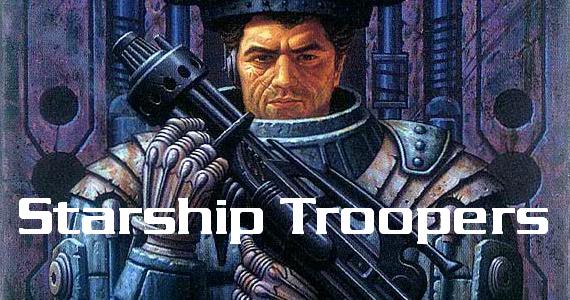
Starship Troopers.

Robert A. Heinlein’s book Starship Troopers, Is a Science Fiction classic for many reasons. Not least among these is the controversial way that Heinlein uses the book to comment on the idea of militarism, and military service.

The book is centered around the life and experiences of main character Juan “Johnnie” Rico and his exploits in the Terran Federation Mobile Infantry, as he and his comrades fight against the ‘bugs’.
The novel is mainly about the everyday experiences of a ‘grunt’ in training, service and ascension of rank through excellent performance within the structure of the military establishment and the relationships between officers and their colleagues of both higher and lower rank.
Johnnie examines through his narration, after the attack of his home by the ‘Arachnids’ the alien enemy on the planet Klendathu, the voice of society as it first quietly supports an anti-war mentality and how it then changes to that of pro-war policies and movements.
Heinlein’s work on this book is believed to be a defense of his philosophy regarding the use of Nuclear Weapons, and military science in general.

The novel is an essay of sorts, rendering Heinlein’s philosophies in a hypothetical format.
Interestingly enough, Starship Troopers is on all of the U.S. Military branches academy’s reading lists as required reading. Oddly, many of the things that Heinlein wrote about are now considered normal parts of military service, such as being mainly volunteer oriented service, as opposed to conscripted.
The book is full of references to historical wars, and even in its use of slurs towards the Arachnids of Klendathu, Heinlein shows a similarity to the slurs used by American soldiers to its many enemies in war.
Regardless, it is an essential Science Fiction read, as it is the basis for many subsequent Sci-Fi ideas. It is one of the pinnacle books of the genre.
The book is available to borrow from Randolph County Public Library.
Feel free to join us for our next meeting, on Thursday, March 15th in the Meeting Room downstairs.

Tuesday, January 31, 2012

World War Z and the Zombie Survival Guide

This month's Men in Black Book Club books are World War Z: an Oral History of the Zombie War, and The Zombie Survival Guide: Complete Protection from the Living Dead, by Max Brooks.

Brooks, son of famous comedian and movie director, Mel Brooks, wanted to create a scenario within both books that seemed completely real and feasible.

The books differ from one another quite a bit in their style and approach. In the survival guide (published first), he attempts to give the background of the zombie virus, highlight important outbreaks throughout history and give a comprehensive plan for surviving a zombie outbreak.

The Zombie Survival Guide gives all of the appearances of a nonfiction reference book, and aside from the zombies, is completely accurate.

In the second book, World War Z, Brooks takes a completely different approach. He writes from a first person perspective, interviewing  key players in the conflict, looking back in an attempt to identify the main issues which lead to the collapse of global integrity in the face of the undead plague.

Together, both books serve to enhance the realism of an otherwise fictional situation.


As is the case with zombie literature and film, it is an ideal format for making social commentary. And Brooks does just that. He places mainstream politics, government, economy and religion under scrutiny, when he puts fictional pressure on the foundational aspects of security, safety and response to emergency situations.

The books are both available to borrow from Randolph County Public Library.

Feel free to join us for our next meeting, on Thursday, February 16th in the downstairs Meeting Room.

Friday, December 30, 2011

Robopocalypse

Robopocalypse, the latest book by Daniel H. Wilson, a PhD. robotics engineer in the Robotics Institute at Carnegie Mellon University in Pittsburgh, Pennsylvania, pits humans against an ‘evil’ AI intelligence systematically destroying humankind.
In the book, Wilson gives a close-up, first person look back at the human struggle against artificial intelligence gone mad. In the same vein as the Terminator film series, though without the time-traveling cyborgs, Robopocalypse paints a picture from the onset of the war, through to the end of the conflict told by the experiences and personal observations of the major characters.
Each chapter is a compilation of the robotic surveillance from CCTV and personal interviews combined with the personal account of Cormack Wallace. Much of the story is related by Cormack 'Brightboy' Wallace, head of the Brightboy Squad, a force of human rebels leading a D-Day-like offensive against Archos, the robotic intelligence responsible for the machine's war on humankind.
Archos is convinced that the only way to save all life is to destroy humankind. He immediately begins a campaign to usurp all of the world's technology, including cars, phones, and computers, to eliminate mankind.
The plot is vaguely a composite borrowed from the genre's general theme: that of a mechanical or software based intelligence taking over. And as such, Wilson adheres to certain plot rules. Archos is not necessarily against all life or in any way even very malicious. It merely seeks to save life from humanity, which it sees as the biggest threat itself.
In that it fits into a similar genre of robotic war and human eradication, is the best aspect of the book. The characters are deep and full of ethos, not so much because they face destruction, which they assuredly do, but rather, because they are more or less human, and in comparison to their common enemy, each character's morality seems to hold no sway on the reader.
Wilson's construction of the book, that of showing the end first, and remembering the events through personal recollections of the characters, and how each individual's experience shows important aspects of the conflict, resembles the format used by Max Books in World War Z. Although apocalyptic literature can only be done in a handful of ways before becoming formulaic and 'done', Wilson's structural style, his characters, his obvious knowledge of robotics and his entertaining, if not altogether original approach, makes Robopocalypse a great read for science fiction fans.